Little Unicorn: Injecting Playful Magic into Every Design
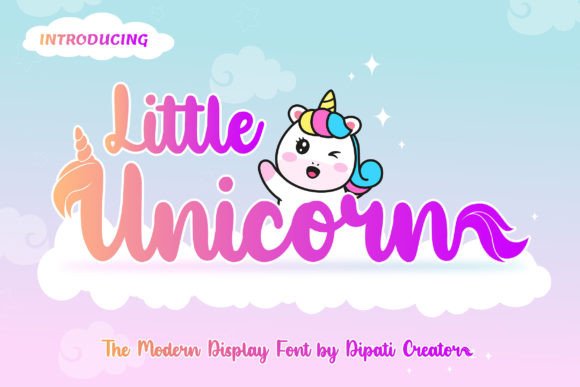
There’s a specific kind of challenge that arises when a project needs to feel personal, whimsical, and undeniably fun. We often spend hours scrolling through archives of standard sans-serifs and stoic serifs, searching for that spark of personality that will make a design resonate. When you finally land on a typeface like Little Unicorn, the relief is palpable. It isn’t just a collection of letters; it’s an experience. This font captures a specific mood—think birthday parties, boutique bakeries, children’s apparel, or celebratory invitations—where the goal is to make the viewer smile before they even read the message. It’s the typographic equivalent of a warm hug, offering a jolly and incredibly charming presence that commands attention without shouting.
The Anatomy of Charm: What Makes This Typeface Stand Out
At its core, Little Unicorn is a display font, meaning it is designed to be used at larger sizes where its intricate details can shine. But what sets it apart from other playful scripts is its authenticity. Many novelty fonts can look cheap or garish; Little Unicorn, however, balances its playfulness with a sense of quality craftsmanship. The baseline is fluid and the character shapes are inviting, creating a rhythm that guides the eye naturally across the page.
The real magic, however, lies in the alternates. If you’ve ever typed out a word only to find the connection between two letters looks awkward or repetitive, you know the frustration of working with lower-quality script fonts. Little Unicorn solves this by offering a treasure trove of stylistic alternatives. This allows for a custom look that mimics hand-lettering. Because it is PUA encoded, you don't need to be a tech wizard to access these features. Whether you are using a professional design suite like Adobe Illustrator or a simpler interface like Canva, you can easily access every glyph, swash, and tail. This accessibility is crucial for small business owners who may not have extensive training in OpenType features but still want a premium result.
Strategic Branding: More Than Just a Pretty Face
For entrepreneurs and brand strategists, typography is a silent ambassador. Choosing Little Unicorn for a brand identity is a strategic decision to position a business as approachable, creative, and customer-centric. Imagine this font on the logo of a children’s boutique, a pet grooming service, or a custom stationery shop. It immediately sets expectations. It tells the customer, "We are friendly, and we care about the details."
However, using a display font in branding requires a bit of strategy. You wouldn't want to use Little Unicorn for body copy or long paragraphs; its charm would become noise, and readability would suffer. Instead, it should be reserved for high-impact moments: the masthead of a website, the main headline of a brochure, or the logo itself. When paired with a clean, modern sans-serif or a simple serif font for the body text, the contrast creates a professional hierarchy. This pairing ensures that your brand feels both exciting and trustworthy. For example, using Little Unicorn for a "Thank You" card insert or a package header turns a transactional moment into a memorable brand interaction.
Practical Applications: From Screen to Print
The versatility of a creative font like this is often underestimated. While it shines in digital spaces, it translates beautifully to physical products, which is vital for businesses selling merchandise or stationery.
- Packaging Design: If you are selling handmade goods, Little Unicorn adds that "artisanal" touch. It looks fantastic on labels for jams, candles, or beauty products where the packaging needs to convey a handcrafted vibe.
- Social Media Graphics: In the fast-paced scroll of Instagram or Pinterest, you have milliseconds to stop a thumb. A bold, whimsical header in Little Unicorn can break the pattern of standard corporate fonts. It works exceptionally well for quotes, sale announcements, and story highlights.
- Monograms and Stationery: The prompt mentions its utility as a monogram, and this is one of its strongest suits. The swashes allow you to create elaborate, intertwined initials perfect for wedding invitations, wax seals, or personalized gifts.
- Editorial and Web Design: For bloggers, using this font for pull quotes or section headers can break up long blocks of text, adding visual interest and pacing to an article. It keeps the reader engaged by offering a visual "breather" that is aesthetically pleasing.
Navigating Readability and Licensing
One of the most common pitfalls in using decorative fonts is sacrificing readability for style. With Little Unicorn, you need to be mindful of kerning (the space between letters) and tracking. Because the characters have swashes and tails, they can sometimes overlap if the text size is too small or the tracking is too tight. Always zoom out and check the legibility of your text from a distance. If you are designing a poster, for instance, step back from your screen. Can you read the headline instantly? If not, adjust the letter spacing.
Furthermore, when downloading assets like Little Unicorn, always review the licensing. As a commercial font, it is an investment in your business assets. Ensure that the license you purchase covers your intended use—whether that is for a single client project, unlimited commercial use, or strictly digital products. Understanding these terms protects you legally and ensures you are respecting the work of the type designers who created these magical alternates.
Conclusion: The Value of Personality
In a landscape saturated with generic design, having a tool like Little Unicorn in your library is a significant advantage. It allows you to inject personality, warmth, and a touch of magic into your work without needing to commission expensive custom lettering for every project. Whether you are a crafter looking to elevate your Etsy shop, a marketer aiming for higher engagement on social assets, or a designer building a whimsical brand identity, this typeface offers a practical, high-quality solution. It reminds us that design doesn't always have to be serious; sometimes, it just needs to be fun.